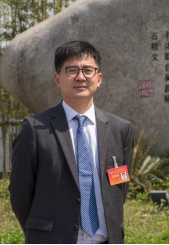
李庆峰,男,汉族,1975年5月生,粒子物理与原子核物理专业,理学博士,德国洪堡学者,二级教授,博士生导师,国务院政府特殊津贴专家,浙江省“万人计划”科技创新领军人才,浙江省“151”人才工程第一层次培养人选,浙江省高等学校钱江高级人才特聘教授。曾任湖州师范大学学科建设与规划处处长、研究生处处长、理学院院长,现任湖州师范大学副校长。
一、学习和工作经历
2008-至今 湖州师范大学 教师
2007-2008 德国法兰克福FIAS 青年学者
2004-2006 德国法兰克福FIAS 洪堡学者
2002-2004 中科院理论物理研究所 博士后
1999-2002 中国原子能科学研究院 博士
1993-1999 西北大学 本硕连读
二、通讯方式
办公地点:湖州师范大学明达楼525室
办公电话:0572-2322108
电子邮箱:liqf@zjhu.edu.cn
三、研究方向
1.微观输运理论
2.核物质状态方程
3.大入射能量尺度下的核反应
4.机器学习在核物理中的应用
个人科研主页:https://orcid.org/0000-0002-8275-8100
四、基金项目
先后主持7项国家自然科学基金项目(含重点项目1项)、1项中德合作科研项目、4项省部级科研项目、1项省级教学项目;作为单位负责人参与1项科技部重点研发计划项目。正在主持的重点项目和参与的重点研发项目信息如下:
1.重离子核反应中2-4倍常密区多粒子自洽微观输运研究,国家自然科学基金委,重点项目(总经费:239万元),2024.01-2028.12,主持;
2.弱束缚核反应的新现象与原子核的奇特结构研究,国家自然科学基金委,重点研发项目(总经费:1900万元),2023.12.-2028.12,参与。
五、奖励和荣誉
2025年,中核集团科学技术奖二等奖
2025年,中国核学会自然科学奖三等奖
2023年,第八届中国科协优秀科技论文(学生高泽鹏为第一作者)
2022年,《Nuclear Science and Techniques》期刊优秀论文奖(学生李鹏程为第一作者)
2020年,浙江省自然科学奖二等奖
2015年,《中国科学:物理学 力学 天文学》“期刊贡献奖”
2014年,北京市科学技术三等奖
2012年,浙江省青年五四奖章
2011年,第四届湖州十大杰出青年
2004年,第二届胡济民教育科学奖
六、指导学生
硕士生:黄智龙(2023级)、沈况(2025级)、盛赞(2025级)
博士生:南满子(中国科学院大学,2020级)
联合培养硕士生:郭琛琛、黄贤军、李淼、邹丽艳、刘洋阳、杜雨珊、叶云霄、童璐瑶、李甫鹏、崔特、杨佳烨、高泽鹏、高波、肖逵、李志龙、陈钰泽、王莹、向希龙、刘皓宇(在读)、梁恩培(在读)、杨益(在读)
联合培养博士生:袁颖、王永佳、郭琛琛、郭文梅、李鹏程、魏国俊、牛庆林、沈一凡、李志龙(在读)、岳晓清(在读)
七、主要论文
已发表学术论文160余篇,其中SCI论文140余篇。近5年部分代表作:
1.Xiaoqing Yue, Pengcheng Li, Yongjia Wang, Qingfeng Li*, Fuhu Liu, Effects of the centrality determination method for the equation of state and nucleonic observables from Au+Au collisions at √sNN=2.4 GeV, Phys. Rev. C 113, 024905 (2026).
2.Zhilong Li, Yongjia Wang*, Qingfeng Li* , and Bing-feng Lv, Machine-learning predictions for the nuclear charge radius: Bayesian method versus decision-tree-based algorithm, Phys. Rev. C 112, 014312 (2025).
3.Guojun Wei, Pengcheng Li, Yongjia Wang*, Qingfeng Li* and Fuhu Liu, Machine learning the in-medium correction factor on nucleon-nucleon elastic cross section, J. Phys. G: Nucl. Part. Phys. 52, 015107 (2025).
4.Yongjia Wang, Bo Gao, Guojun Wei, Pengcheng Li, and Qingfeng Li*, Time evolution of elliptic flow and medium density in heavy-ion collisions at intermediate energies, Phys. Rev. C 110, 044606 (2024).
5.Manzi Nan, Pengcheng Li*, Yongjia Wang, Qingfeng Li*, Wei Zuo, Isospin-dependent in-medium nucleon-Delta elastic cross section, Eur. Phys. J. A 60, 131 (2024).
6.Zhilong Li, Zepeng Gao, Ling Liu*, Yongjia Wang, Long Zhu, and Qingfeng Li,Importance of physical information on the prediction of heavy-ion fusion cross sections with machine learning, Phys. Rev. C 109, 024604 (2024).
7.Wanbing He*, Qingfeng Li*, Yugang Ma*, Zhongming Niu*,Junchen Pei*, and Yingxun Zhang*, Machine learning in nuclear physics at low and intermediate energies, SCIENCE CHINA Physics, Mechanics & Astronomy, 66, 282001 (2023).
8.Pengcheng Li, Jan Steinheimer, Tom Reichert, Apiwit Kittiratpattana1, Marcus Bleicher, and Qingfeng Li*, Effects of a phase transition on two-pion interferometry in heavy ion collisions at √sNN = 2.4-7.7 GeV, SCIENCE CHINA Physics, Mechanics & Astronomy, 66, 232011 (2023).
9.Bo Gao, Yongjia Wang*, Zepeng Gao, Qingfeng Li*, Elliptic flow in heavy-ion collisions at intermediate energy: The role of impact parameter, mean field potential, and collision term, Phys. Lett. B 838, 137685 (2023) .
10.Yongjia Wang, Zepeng Gao, Hongliang Lü, Qingfeng Li*, Decoding the nuclear symmetry energy event-by-event in heavy-ion collisions with machine learning, Phys. Lett. B 835, 137508 (2022).
11.Hermann Wolter, … Qingfeng Li et.al, Transport model comparison studies of intermediate-energy heavy-ion collisions, Prog. Part. Nucl. Phys. 125, 103962 (2022).
12.Pengcheng Li, Yongjia Wang, Qingfeng Li*, Hongfei Zhang, Accessing the in-medium effects on nucleon-nucleon elastic cross section with collective flows and nuclear stopping, Phys. Lett. B 828, 137019 (2022).
13.Pengcheng Li, Yongjia Wang, Jan Steinheimer, Qingfeng Li*, Hongfei Zhang,, Proton correlations and apparent intermittency in the UrQMD model with hadronic potentials, Phys. Lett. B 818, 136393 (2021).
14.Yangyang Liu, Yongjia Wang, Ying Cui, Cheng-Jun Xia, Zhuxia Li, Yongjing Chen, Qingfeng Li*, and Yingxun Zhang*, Insights into the pion production mechanism and the symmetry energy at high density, Phys. Rev. C, 103, 014616 (2021).